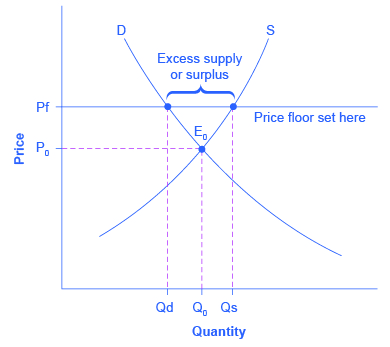
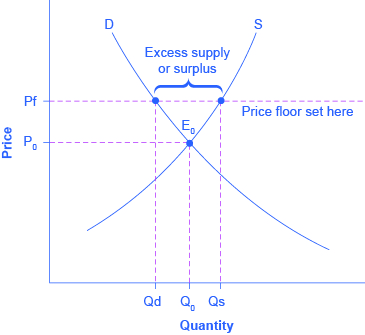
A price floor example.
Price floors and ceilings quizlet.
If the price of butter increases then we would expect that the demand for margarine would fall.
Percentage tax on hamburgers.
Shortage of 0 units.
Learn vocabulary terms and more with flashcards games and other study tools.
For more detail on the effects price ceilings and floors have on demand and supply see the following clear it up feature.
Price ceilings and price floors.
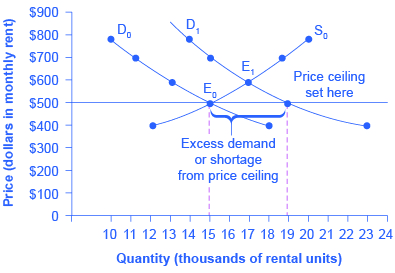
Price ceiling refer to the figure.
The intersection of demand d and supply s would be at the equilibrium point e 0.
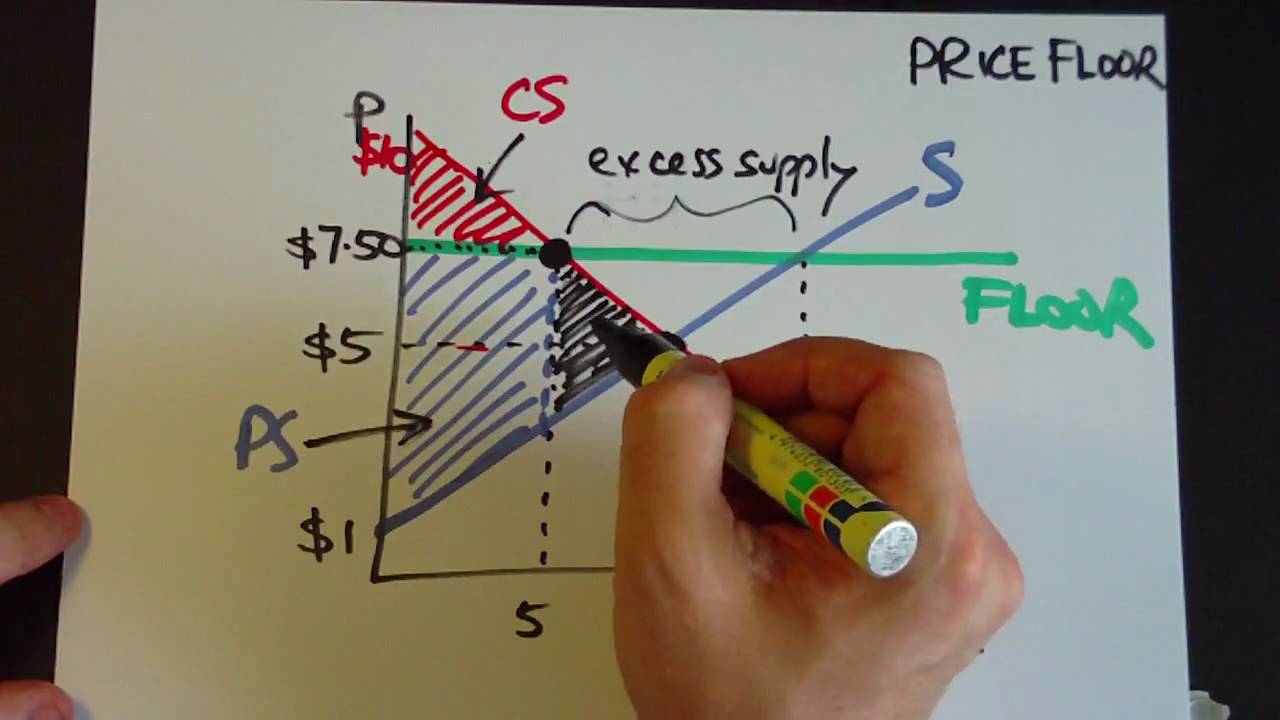
But this is a control or limit on how low a price can be charged for any commodity.
Surplus of 20 units.
If a price ceiling were set at 12 there would be a.
Price floors and price ceilings are price controls examples of government intervention in the free market which changes the market equilibrium.
Surplus of 40 units.
National and local governments sometimes implement price controls legal minimum or maximum prices for specific goods or services to attempt managing the economy by direct intervention price controls can be price ceilings or price floors.
The effect of government interventions on surplus.
The opposite of a price ceiling is a price floor which sets a minimum price at which a product or service can be sold.
This is usually done to protect buyers and suppliers or manage scarce resources during difficult economic times.
Learn 100 online from anywhere in the world.
They each have reasons for using them but there are large efficiency losses with both of them.
This is the currently selected item.
Taxation and dead weight loss.
It is legal minimum price set by the government on particular goods and services in order to prevent producers from being paid very less price.
A price ceiling is the legal maximum price for a good or service while a price floor is the legal minimum price.
Like price ceiling price floor is also a measure of price control imposed by the government.
Shortage of 50 units.
In the 1970s.
Example breaking down tax incidence.
Taxes and perfectly inelastic demand.
Price and quantity controls.